Showing posts with label From Freshmeat to Team Mate. Show all posts

Tuesday, September 2, 2014

From Freshmeat to Team Mate: Where Your Balance Can Take You

So, in previous posts I've talked about how the Derby Stance is important because the lower a skater can stay, the lower they can keep their center of gravity, the easier it is to maintain their balance. Derby girls work out a ton to get their legs in shape, not just so that we can all rock a skirt whenever we choose, but to become better, tougher skaters.  So many things that you do while playing not only involve hitting or blocking or skating at high speed, but being able to maneuver yourself into the proper positions on the track so that you can DO those things! If you have poor balance, (and even at six months in, I know I STILL need to work harder to improve my leg strength and balance) you won't be able to turn, avoid a block, or weave between players effectively.

As a freshmeat player, how do you start to learn proper balance and the skills that build on it?  One step a time.

Consistently and constantly trying to deepen and strengthen your Derby Stance is step one.

Photo from Livestrong.com
Learning to be able to balance on one skate at a time is step two.  As part of the Level One test, I had to be able to Balance on One Foot for thirty seconds on each side.  Now, trust me, you don't have to be able to do what that skater on the left pictured is doing, but you do have to keep one foot off the floor for that half a minute.  It's funny, I've done yoga - sometimes I can hold a mean tree pose - and I felt as if I had decent enough balance, until you put wheels under my feet.  I had to work really hard to engage my core and focus on an unmoving point at a decent distance away from me in order to maintain the strength to keep that one foot off the floor, for what should be a relatively short period of time. Especially on my weaker leg.

Fresh meat skaters at Chinook City Roller Derby
working on their balance.
Step three is taking that one foot balance and moving.  You'll see a lot of more veteran Derby skaters using a One Foot Glide to stay on the track after taking a hit from another player, to maneuver around a fallen player, or to sneak past the pack really quickly.  During Freshmeat training, though, the object is just to be able to glide for a decent distance (usually about 1/4 - 1/2 of the track) solely on either foot.  Starting out, it was disconcerting to have to pick one foot up and pray as I rolled along. Soon, though, I found myself remembering how much I had loved to do just that skill as a kid, skating through my neighborhood.  I discovered that not only do I feel confident rolling along a straight path on one skate, but that with enough oomph and the proper lean (again like on a motorcycle - leaning so that your shoulders and hips point in the direction you want to turn) that I even feel great doing a One Foot Glide on a Turn! Slowly over the last few months, I've embraced this as one of my favorite warm up activities.

Once you've developed the strength and honed your balance so that you can effectively tackle these beginning steps, these become the building blocks for so many other skating skills used in Derby. Even some of the more difficult Level One skills like stationary stepping, turning 180 degrees while skating, and developing good crossover strides require the basics of being able to balance and skate on only one foot for at least a few seconds.  Next time, I'll talk about how these helped me to do some of the more advanced skills and little tricks I picked up along the way.

Until next time...
Nikki Tesla #134

Tuesday, August 19, 2014

From Freshmeat to Team Mate: Getting My Gear - Part 2!

In my last post, I talked about picking out most of my basic safety gear.  Today, I want to focus in on finishing my discussion of Derby gear by talking about what I think may be the most important pieces of all - the mouthguard and SKATES!

When I started freshmeat training, one of the first requirements was that we had to have a mouthguard.  So, of course, I ran out to Dick's and grabbed a cheap mouthguard - one of those big clunky ones that hockey players use.  I hated it.  Absolutely hated it.  I'd forgotten how much I'd hated wearing one when I played soccer years ago.  It made it hard to breathe, I had to constantly think about holding it in my mouth, and because it had some rough edges and I have a smaller mouth, it actually tore up the insides of my upper lip and gave me painful cuts.  Not fun.

MoJo wearing her Sisu Mouthguard
In talking to just about everyone else on the team, I learned that almost EVERYONE uses SISU mouthguards.  I ordered one online right away and when it came and I tried it, OMG the difference was immediate and amazing.  These mouthguards are so thin that I put it on and pretty much forget it's there.  I never have to worry about it coming off mid-practice and not only can I drink water with it in, but I can almost talk normally... so great.  I HIGHLY recommend them! For more info about actually getting and forming a SISU mouthguard, you should check out the post one of our other skaters, MoJo, did when she got her new SISU mouthguard.

The final piece of my "freshmeat" gear package was, of course, my very own skates! When I went up to Bruised Boutique in New Hampshire, I had no real idea what I was looking for in skates, only that I had a basic price range I was trying to stay within.  As a brand-new skater, I didn't want to spend more than two hundred dollars on my skates in case a year from now I decided Derby wasn't for me.  What's great about going to Bruised is that armed with only that price range to start with, I was able to go and try on several different styles of skates to see what I liked.  I have to admit that trying them on was sort of like shopping for my wedding dress years ago, once I tried the right pair on, I just knew.  They felt right...at least then.
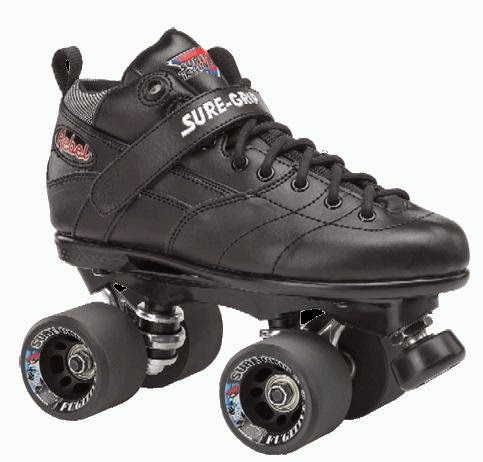
Sure Grip Rebel Fugitives. 

What I went with were Sure Grip Rebel Fugitives. I could list off the specs for you, but that's really not at all why I chose them. I put them on and they felt cushy in all the right places.  They didn't feel too tight and I could go up on the toe stops comfortably.  They felt great. In finishing my freshmeat training and taking my Level One test, they were such a step up from the sneaker skates I'd been skating on originally that they felt like a dream.

Months later, though, gearing up to pass my Level Two test, and skating more and more in real drills with our rostered skaters, I can identify now some of the things I'd like to change when I get my next pair of skates.  And yes, it's only been about four months, but I've already started falling into the Derby trap of dreaming about my next gear upgrade. LOL.

It was only through practical experience and lots and lots of laps that I realized the cushy boots on these skates are a little too wide for me.  My right foot slides around inside the boot giving me wicked cramps if I don't lace my boot almost tight enough to cut off the circulation on that side.  Any practice nights where we do lots of lateral movement also creates the same sliding/cramping issue.  Most of the time, though, they're survivable.  I've started experimenting with lacing them differently
My skates with the Radar Bullets
and upgraded toe stops (Gumballs).
to see if it makes a difference.  The next time I go to do a lap test I may also try wearing double socks, I'm not sure.  It's all still a learning process for me.

In fact, in the last two weeks, I've started trying out different wheels to see how that affects my skating.  My skates originally came with 92 Fugitives, which are a fairly grippy wheel, highly recommended for freshmeat skaters.  When just learning all the basic skills they worked well.  As I've been tackling more advanced skills, though, I realized that combined with our wooden indoor roller rink floor, my Fugitives were maybe a little too grippy for some things.  One of our co-captains, Suga Burn, lent me a pair of her wheels, 97 Radar Bullets and the difference they've made in trying to do things like plow stops has been amazing!
My skates with the original
Fugitives in a wheel bag.

When I go to do laps with the 97s on, though, I'm having a new problem and am feeling SO slippery that I tend to slide out all over the place.  Hopefully, Astra will be lending me her 93 Radar Bullets soon and I'm going to try to put those on as "pusher wheels," keeping some 97s, and get some grip mixed in that way, allowing me to do things like plow stop but also hold tight through turns.  Until I have really figured out exactly what type of Derby skater I'm going to be and what I will need from my skates, I feel like there's going to be a lot of trial and error in learning about boots, wheels, plates, and other skate parts and how they can change the feel when you skate.

Since I probably won't spend another couple hundred dollars on new skates anytime soon, at least finding a potential upgrade in my wheels is a better, less expensive way to up my game without breaking the bank.  I really wish there was a place you could go to just try on different wheels and sort of "test drive" them like you would a car before buying, but for now I can borrow some skaters' extra wheels and narrow options down a little bit that way!

Until next time...
Nikki Tesla #134 

Tuesday, July 29, 2014

From Freshmeat to Team Mate: Getting My Gear!

Last post, I mentioned that I would tell you all about picking out my own gear.  In the process of drafting, I realized that this is probably going to have to be broken into several posts.  There's just too many things to talk about! Today, we'll start with picking out the required safety gear.

Since our team's in Western Massachusetts, there are only a couple of options for places that you can go and actually try on Derby gear before purchasing.  There's the Pro Shop at Ron A Roll Skating Center in Vernon, CT, though they only have a small selection of Derby gear in stock.  You can pick up hockey helmets at most sporting goods stores like Dicks or Modells, and some skateboard shops like Theory Skateboarding carry a small variety of knee and elbow pads that can be used for Derby. For most of us in Southern New England, though, the best place to go and get gear is definitely at Bruised Boutique in NH.

An interior shot of the Bruised Boutique store in NH. 
Bruised Boutique is the world's largest Derby store and is the only one is the area that is devoted to just Derby gear and accessories.  It's almost a rite of passage for Derby skaters in our area to go with a veteran team mate to pick out their first set of gear. I was lucky enough that within the first six weeks of my Freshmeat period, my awesome coworker who you know as Duck N. Shover (who writes our "Officials' Review" posts) and his lovely wife, Astra Knot, who also happens to be our Team's 2014 Chairperson were willing to take me to Bruised to get my gear.

A few days before we actually drove up there, I spent some time checking out their online store trying to make a list of things I desperately needed and trying to figure out exactly how much I was willing to spend.  I quizzed other POD skaters to see what they loved about their gear and what items they would swap out if they could.  I knew, no matter what, that I had to buy at least the essentials: A helmet, elbow pads, wristguards, knee pads, a mouthguard, and the ultimate - SKATES! The question was, should I buy cheaper "freshmeat" versions of the gear, or should I invest now in better equipment?

As a Derby skater, I want to have fun, of course, but I'm also really concerned with being safe.  It was very important to me that I get a decent helmet to protect my head, especially since I knew I'd still be falling a lot. Derby skaters are starting to be very cognizant of the importance that Derby helmets be rated for multiple impacts since we do fall and protecting the head is a number one priority when playing.  In fact, many players are actually switching over to hockey helmets which are designedto be even safer, but for my first helmet, I wanted one that would be safe and also look pretty. I'm not afraid to admit it.  I went with a Triple 8 helmet in purple since that's our team color.  The foam padding on the inside is also removable for washing which is a great feature to help keep it from getting stinky!

Next, I focused on knee pads.  Knowing that I was still falling a LOT in practice, I wanted to get really good knee pads.  This was a place that I was happy to spend a little extra money to get better equipment.  Now, Derby knee pads all pretty thick and sturdy, but as I mentioned before, they also have a hard shell on the front and this feature can vary from pad to pad.  When I was using the Freshmeat gear, I had been using a pair of 187 knee pads, which I liked a lot.  I knew I wanted to stick with that brand, but they make different kinds, so I researched how they differed.  I decided to go with their most expensive type - the 187 Pro Derby Knee Pads - because they have removable, replaceable shells on the front.  This set is about ten dollars more than the regular ones, but when you fall several times really hard on your knee pads and finally crack one of the shells, rather than having to replace the whole set of knee pads, you can just buy the replacement shells for the front. It can save some decent money in the long run.

For elbow pads and wristguards, I was less concerned with getting top of the line gear.  Personally, I feel
like while you absolutely need these items, you should be way more concerned with your knee pads since you do the hardest falling onto those.  I could spend a little less here.  Mostly it was about fit and comfort.  I tried on a couple of brands for the elbow pads and found that some of them had different shapes for the hard shells on the elbow.  I really liked the flatter shape of the Triple 8 pads, as opposed to some of the ones that felt more like cups, and so went with those.  In the wristguards, there are several different styles, as well.  Some are one solid piece that slides over the wrist and then has a strap to hold it in
place.  The ones I chose open flat so that you can place your wrist into it then tighten the three different straps (one on your hand, one on the small of your wrist, and one on the beginning of your forearm) to hold it in place.  I felt like I had more control in adjusting the tightness in these three different spots to get the most safety and comfort out of the guards. Since these Triple 8 ones were some of the cheapest in the store, I'm already noticing wear and tear on them. I may have to get replacements soon, but I think I'm going to stick with the same kind when I do.

Next time, I want to finish up with safety gear and tell you about getting my very own skates!

Until then...
Nikki Tesla #134 

Tuesday, July 15, 2014

From Freshmeat to Team Mate: Falling Down and Getting Back Up Again

Great illustration by Dusty Melling
So, one of the best known things about Derby is Falling.  Whether it's because you lost your own balance or because someone else hit you, you will fall down. A lot.  When I joined the team, one of the first things anyone ever said to me is "Mentally prepare yourself. You will be falling a lot. A lot.  Most of the time, though, it's okay and doesn't even hurt."  At first I was skeptical, but outside of a really bad hit, they were
right.

In Derby, you fall down.  You fall down a lot.  BUT... you also learn how to fall and with your pads and the right technique, nine times out of ten, you really don't feel it!

You may be skeptical, but those pads really do make a HUGE difference.  I had no idea, having never seen any up close before gearing up from the freshmeat bag, but derby knee pads about three inches thick with a hard shell on the front.  When you fall properly on to these pads, landing on the shell, not only do you get a really good cushion, but you should theoretically slide a little on the floor, which also helps to distribute the impact.

The 187 Killer Pads Pro Derby knee  pads
that I bought at Bruised Boutique
Now, coupling these nice, thick pads with a proper falling technique is the ultimate goal.  In Derby, we now refer to learning the art of falling down and getting up again as learning RECOVERY.  The focus is on acknowledging that you will fall and learning the best ways to control it and then to get up again as quickly as possible.  You do not want to make yourself a target for other players (or even refs) to fall over on the track!

Though there are several different types of "recoveries" that you learn and get tested on in Derby, the one thing they all have in common is that they involve falling forward.  While as I mentioned in a previous post, that all players are required to wear helmets, mouthguards, elbow pads, knee pads, and wristguards, there are no rules about any other equipment.  There are players that wear padded shorts to protect their tailbones in accidental backwards falls, but the general practice is to learn to fall forward so that you will be protected by the required gear.  Thus, as a freshmeat skater, you will spend at LEAST one practice on learning the three basic fall "recoveries." (I know I did. This practice WIPED ME OUT!) You will learn:

*Single Knee Taps - These are honestly my least favorite, though probably the most useful in a game situation. The idea here is to recognize when you are losing your balance, and to just tap your knee, one or the other, on the floor long enough to help stabilize you then pop back up to full skating, without touching the floor with your hands (Fingers make excellent targets for other skaters' wheels...).  Easier said than done, LOL. Originally we practiced these by skating back and forth up and down the rink just alternating knees on the floor.  My quads were screaming! I also could only do about three or four before I'd lose my balance completely and need to reset before doing any more.  Having practiced these for months now, though, I can say that doing one for the purpose it's truly intended is both useful and much easier than it was when I first started.

One of POD's skaters landing in a double knee slide
during a bout with Elm City.  
*Double Knee Slide - This is sometimes referred to as the "rock star slide." Here, again, you should
Here's a pic from a game we had with the Elm City team.
See how the Elm City player on the left has positioned
her legs to recover to standing? *We just try not to use
our hands like this...
recognize that you are on your way to the floor..Then the best practice is to squat so that you are already halfway to the floor and then allow yourself to land on both knees and slide forward.  Ideally, you should land on your knees in a staggered motion, not at the same time, which helps to lesson the direct impact on your knee joints.  You also should keep your arms up and close to your chest to avoid either landing on your own hands/fingers or potentially creating a smooshed finger situation if someone else rolls over your fingers on the track.  To recover from this type of slide, you then bring one knee up, creating a 90 degree angle with the track and use the leverage pushing on that skate (and your quad muscles in that leg) to propel you up again to regular skating position.

*Four Point Fall - This final fall and recovery is both the easiest in a way and the toughest.  This is a full fledged fall to the ground.  It is called a four point fall because four parts of your body should land on the floor if you do it properly.  Again you should be able to recognize that you will fall. Then, the goal is to first fall on to the knees as if you are doing a double knee slide (points one and two) and then to continue falling onto your forearms (points three and four). Hands should be fisted and arms bent at a ninety degree angle so that you land on the flat of your forearms with your thumbs on the top of your fists.  Your head should be tucked down near the forearms, but not between them, so that you are both protecting your head if another player trips on you, but you are not smashing your face on the ground. Recovery builds on the same principles as the earlier falls - bring upper torso upright, then bring up one knee, brace and lift to skating
position.

A POD player lands in a four point fall during a game,
tucking in to avoid injury. 
The best principles for Recovery in Derby, no matter how you fall, are to FALL SMALL and to RECOVER, RECOVER, RECOVER (ie. get up quick!) The less time you spend down on the track, the better for all players involved.  You are much less likely to get accidentally run over and if you're like me, you want to be back in the action! So, falling safely, making yourself a small target, and then getting up and back in the game as quickly as possible are things that we actually practice because you know that you'll be doing them in a game.  Even the best Derby players fall.  They just fall better than the rest of us. *grins*

Now that we've talked about falling and recovery, I suppose I should go a little more in depth about my safety gear!  Next time, I'll talk all about how I picked out my skates and such up at the Bruised Boutique in New Hampshire. It's an awesome derby gear store.

Until next time...
Nikki Tesla #134 

Monday, June 30, 2014

From Freshmeat to Team Mate: Level One Skills Begin

Last week, I explained one of the core skills needed for Roller Derby, the Derby Stance. For the first few practices I attended, we spent at least a few minutes working on learning proper derby stance form. Our freshmeat coach and the team's regular coach both suggested we all do tons of squats. I still do squats at random times every day...a favorite is while I'm waiting with my dogs in the backyard. I actually need to start doing them in regular sets, working to get as low as possible.
Squats are good for
POD players in one of this season's
games. Notice Macrum's great skating
Derby stance up front!
building your leg strength for skating, perfecting the form of your stance, and building strength in the tendons of your ankles and knees, which can help prevent injuries.

Aside from learning to stay low for balance while skating, I remember spending the first few practices learning to skate with all eight wheels on the floor and the basic derby stop, the t-stop. It sounds silly that we had to learn how to skate with all the wheels touching the floor, but we did! Aside from being able to skate forwards or backwards on all eight wheels, by learning how to use the edges of your skates - inside, outside, or a combination of the two - you can develop the skills to weave, turn, or slolam while skating.
This skater is using her edges to turn
 left on the track. From Decat#6

By putting pressure on the outside edge (two wheels) of your left skate and pressure on the inside edge of your right skate, you will find yourself leaning to the left and then your body naturally begins to turn in that direction.  If you reverse your edges, you turn right. By alternating between the two, you can go around turns and weave through cones (or later opponents!) without taking your feet off the floor.

It sounds simple enough, but using your edges is like riding a motorcycle. You have to lean into all your turns and trust that you won't just fall over. Veteran skaters make it look easy but it took me months to really get the general hang of it. Most people, including myself, are stronger leaning and turning to one side, too. However, over time and with the right equipment (good skates with well-adjusted trucks that allow your feet to maneuver without pulling your wheels off the floor), it becomes almost second nature.

When I started as Freshmeat, I did not have skates of my own. I borrowed the only pair of freshmeat skates that would fit me - some sneaker skates like the ones pictured here. They were free to use, which was great while I was figuring out if I could actually make a go at Roller Derby. What they weren't, was flexible (or light, honestly!).  Trying to find my edges was near impossible. I would lean and nothing happened. Switching to my own Derby quad skates weeks later made a huge difference.

It was the same with learning to do a t-stop, though in this case the heavy skates helped a little, I think. A t-stop is the first real stop you learn in derby. It's fairly simple. You transfer your weight to whichever leg you put in front. Then by dragging the other foot behind (making the shape of the letter "T") you cause friction with the track, which slows you to a stop. You have to be careful to drag with the outside edge of the back skate so that you don't hurt your ankle by accident. Check out this simple video explaining it nice and clearly!


Learning to do the t-stop originally in those sneaker skates meant that when I switched to my real skates that they felt like a breeze! I'll tell you guys all about picking out my own gear and skates soon, promise.

Until next time...
Nikki Tesla #134

Monday, June 23, 2014

From Freshmeat to Team Mate: Just Getting Started

So, when I decided to join Pair O' Dice City Roller Derby, I was lucky.  I had two coworkers and another friend already on the team.  It helped a lot on that first night when I got to the rink, bewildered and nervous, to have some familiar faces nearby.  And yet, as I soon found out, I didn't need to be so apprehensive.  Everyone on the team was welcoming and happy to see new freshmeat.

No really. It could have been this big, scary moment to come in and immediately start doing something new and terrifying that you may or may not kill yourself trying for the first time...but that's not how it works.

With today's safety concerns and regulations, there is usually a very strict and structured process for introducing freshmeat to Derby.  At POD, we had to fill out waiver forms and contact info sheets first thing. Then before even going near the skating floor, we had to get outfitted with safety gear.  The dreaded freshmeat gear. I say "dreaded" because this is the (very nicely) donated old gear from all the skaters on the team.  It's sort of stinky and ill-fitting, BUT, it does the job until you can get your own personal gear.

Some of our team's freshmeat gear.
What type of gear do you need for Derby, you ask?

Well, aside from quad skates, every skater is required to wear these items every time they are on skates:
*Helmet 
*Mouthguard
*Elbow pads
*Wristguards
*Knee Pads

Without these things, you are not allowed to skate and believe me, they check. They check before practice, during practice, and before and during every scrimmage and game. It took some getting used to and it still takes me about twice as long to gear up as the veteran skaters, but I'm glad to know that I HAVE to be safe when I skate.

Once we'd officially geared up, we got to go out onto the track.  First we covered why we have to wear all our safety gear then we skated a few tentative laps.  I seriously had not been on skates in years...so I sort of felt like Bambi wobbling around out there.  I'm sure it was actually pretty hilarious to watch.

I'm the skater in the striped helmet...
relearning what it feels like to be on wheels. 

Most of that first night after gearing up was sort of a forgettable whirlwind.  We got papers that told us about the team and papers that told us what skills we'd be learning to pass our Level One test.  The only other truly vivid memory I have is learning the all important DERBY STANCE.  This is a skill that you build upon with everything else that you do in Derby.

My post-practice shaky legged derby stance.
I can hear Coach now, "Get Lower!" ;)
A good Derby stance is harder than it looks.  You basically work to squat on your skates. You want to be as low as possible. You need to keep your arms in and your core tight.  All of this helps to lower your center of gravity which helps you balance in everything that you do when you're skating.  

When you're stationary, it's easy, but once you start moving it's pretty easy to forget and start to stand up straight while you're skating.  I know that I still work to maintain a good Derby Stance when I'm skating and I strive every practice to learn to get lower. If you watch really great Derby skaters, they all stay amazingly low and it really does help in their speed, their turns, even their blocking and hitting.  It's a great skill to constantly work to improve.  

Until next time...
NIKKI TESLA #134

Monday, June 9, 2014

From Freshmeat to Team Mate: An Introduction!

Hi There!
My name is Jessica...and until recently I was "Freshmeat."
The day I got my very own Derby gear -
I was SO excited to just try the skates on again!

For those of you who may not know, when you join a Roller Derby team, you start out as something called "Freshmeat." It's sort of like a probationary player.  The Freshmeat period allows you to get your feet wet in the world of roller derby. It's full of practices where you just try to remember with envy how well you USED to skate when you were a kid (or maybe that was just me, LOL) or you basically learn how to skate from scratch.

In Freshmeat training, you learn basics.  Real basics.
Here are some quick examples:
*how to do a derby stance
*how to skate forwards
*how to balance on one foot while on skates
*how to skate backwards
*how to turn around while skating

Then, once you've mastered all of your Freshmeat skills (and there's more...just wait and see!) you get to take your test for Level One. After you pass Level One on our team, you can officially be voted in as a full member of the organization, which is great!  I was voted in a few weeks ago after passing my Level One test...and now I'm working on my Level Two skills.

Sweaty from practice, but THRILLED with my
brand-new track jacket with my official name
and number on it! 
All in all, there are three levels of skills that you have to master before you can play in an official Derby game. This level testing is done for safety reasons.  It proves not only to your team, but to the other team, as well, that you can safely execute all the required skills that may be needed in a game.

 In this series, "From Freshmeat to Team Mate," I'm excited to share with you what I've done to this point to pass my Level One test and to hopefully continue as I get all the way through Level Three to become a competitive player on our team.  I'll be showing you different skills we learn and sharing some of my experiences. I hope you find Derby as fascinating and exciting as I do!!

- Jessica a.k.a. NIKKI TESLA #134
(oh, yeah, did I mention when you play Derby you get to pick a cool "Derby Name" to play under?  We have some great ones on our team... "Meryl Creep,"  "Haulin-Sass," "Astra Knot," or "Paleo Pixie." You can check out our player profiles over on the right sidebar --->)